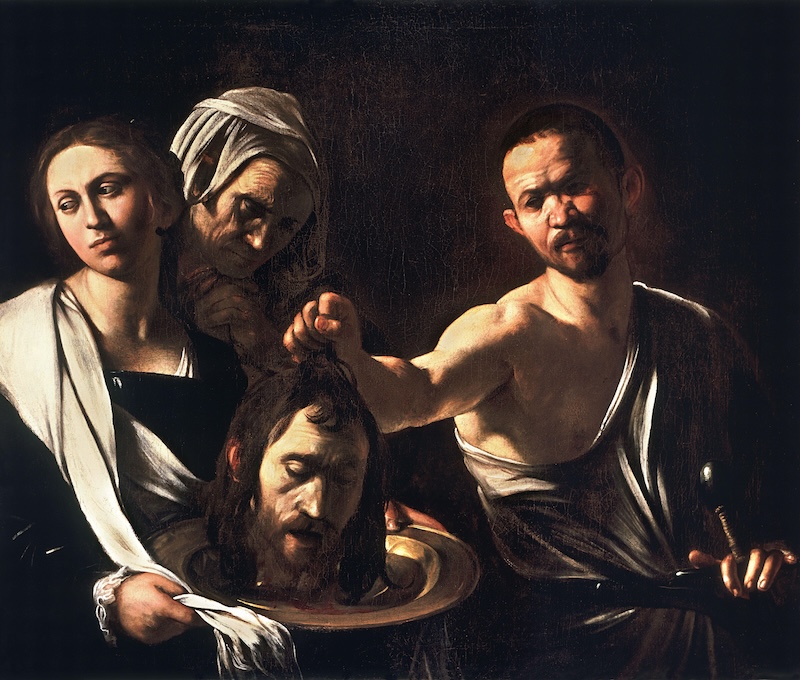
King Herod heard about this, for Jesus’ name had become well known. Some were saying, “John the Baptist has been raised from the dead, and that is why miraculous powers are at work in him.”
Others said, “He is Elijah.”
And still others claimed, “He is a prophet, like one of the prophets of long ago.”
But when Herod heard this, he said, “John, whom I beheaded, has been raised from the dead!”
~ Mk 6:14-16
The beheading of John the Baptist breaks the flow of Mark 6 like an oddly-timed first century commercial. You can almost see Andrew wresting Mark’s pen away to declare “we interrupt your regularly scheduled gospel to give you this breaking story about John the Baptist.”
But if we carefully follow the threads of the story from Mark 6:12-13 into verses 14-17, we begin to see how this odd subplot connects to Mark’s main purpose, which is to narratively demonstrate that Jesus is the Christ.
In verses 12-13, the disciples had gone out in pairs to spread the gospel for the first time. Miracles were occurring, demons were being cast out, and the word about Jesus was spreading more rapidly than ever. However, Jesus’ identity was still an open question for many. Was he the Christ, the promised Messiah? Or was he someone else? A rumor started among the people that Jesus was not, in fact, the Christ, but rather John the Baptist risen from the dead. We know this theory must have been prevalent, because even the pagan king heard about it – and agreed. It doesn’t take a big leap to imagine that this was problematic. Not only do you have a competing resurrection story circulating before the church is even founded, but it has the government’s implicit seal of approval. This could get messy.
So Mark does what any good writer would do when laying out his case –he addresses the counterargument head-on. Through the narrative that follows, Mark not only provides essential background that serves to discredit the belief in “Jesus the Baptist”, but also an excellent apologetic template that he will use himself to prove the credibility of his own argument in Mark and in Acts.
Problem #1: The Credibility of the Witness
As the tetrarch of Judah and Galilee, Herod Antipas was one of the most influential men to have in your corner if you wanted to popularize a theory, especially among the gentiles. However, Mark’s story immediately casts doubts on Herod’s credibility. Not only was this the man who unjustly killed John the Baptist in the first place (following a sordid chain of events involving sexual perversity, domestic infighting, emotional blackmail, and the messy world of politics) but Herod hadn’t even met Jesus at the time he claimed to know his identity (Lk 23:6-8). He had met John and proven that his personal feelings were no match for his love of public approval. John was dispatched on a whim to protect his ego, without so much as a sham trial.
If the people were looking for a champion for their theory, they couldn’t do worse than King Herod.
Problem #2: The Expediency of the Message
Despite the fact that Herod felt obligated to kill John to save face before his officials, he knew that killing him was politically unpopular, for the people believed him to be a prophet (Mk 11:32). Herod himself believed him to be a righteous man (v 20) and was “greatly distressed” at killing the man he once protected (v 26).
But the belief that Jesus was a resurrected John the Baptist? Well, that solved a lot of things. The people got a folk hero and Herod could avoid a PR disaster. This was a belief with tremendous political and personal benefit and no down side. It created the perfect murder.
Matthew Henry notes that Herod’s guilty conscience and his fear of John may also have made him susceptible to this theory. We are always more ready to believe those things that confirm our worst fears, guilts, and biases.
So this belief about Jesus’ identity was not based on substantive fact or experience, but on baseless supposition, self-serving hopes, and self-condemning guilt.
Problem #3: The Occupied Tomb
The most significant problem of all with the idea of a risen John the Baptist is that the disciples personally prepared the body and knew the grave site (v 29). Anyone who cared to check could confirm that a headless corpse still occupied John’s tomb. The disciples could confirm the identity of the remains and point the way to where all the evidence still lay.
The Solution: A Risen Christ
Mark’s solution to the problem was straightforward. Jesus was not John the Baptist, but instead the risen Messiah, testified to by better witnesses, a costly message, and best of all, an empty tomb.
Risen John
Key Witnesses:
Herod (who knew Jesus only by reputation) and “some people” who were arriving at their conclusion solely through speculation.
Risen Christ
Key Witnesses:
God the Father and God the Holy Spirit (through signs and miracles), Jesus himself, 11 disciples, plus Mary Magdelene and Salome (Paul adds that there were over 500 witnesses who saw Jesus before and after his resurrection)
Message:
Politically and personally expedient. Fed into people’s core fears and desires. Many possible motives other than the truth.
Message:
Politically suicidal and personally sacrificial. Went against the grain of people’s core fears and desires. Few to no motives other than the truth.
Tomb:
Still occupied, with an easily-identifiable headless corpse. The disciples could verify the body and the location.
Tomb:
Empty. The disciples could verify the location, but there was nothing left to see.
A sinful world tried its hardest to turn John the Baptist from an attendant of the Bridegroom into a wedding crasher after his death. A legend who would steal the spotlight from Christ, obscuring his identity and hijacking his redemption. But God had other plans. Far from John’s story being a distraction or a scenic detour in Mark’s gospel, in Mark 6, God gives John the opportunity to declare one final time in a way that would echo down the chambers of time “I am not the Christ. Behold the Lamb of God who takes away the sins of the world!”